
How to Run Meta Ads for Lead Generation: A Simple Guide for Indian Businesses
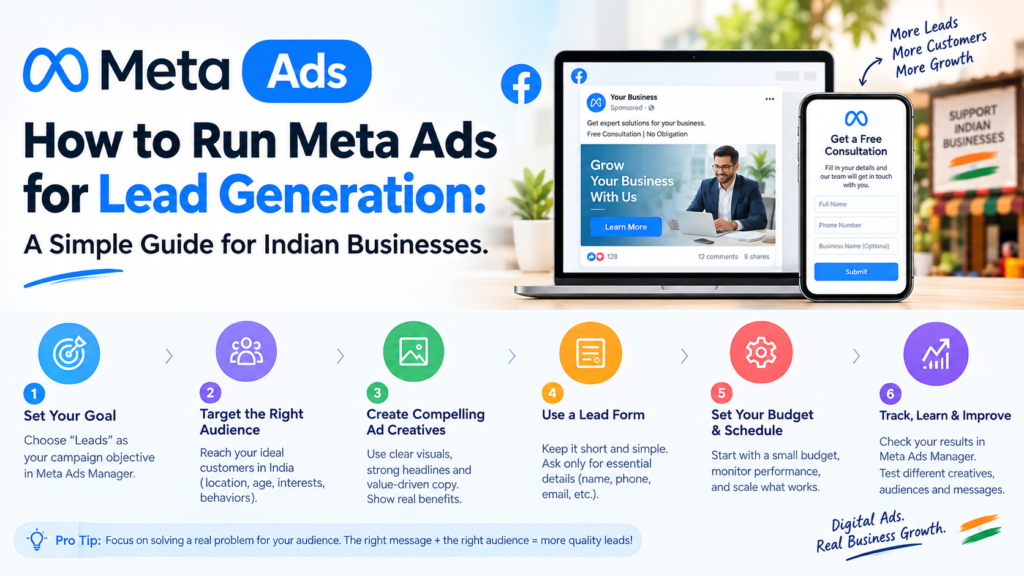
How to Run Meta Ads for Lead Generation: A Simple Guide for Indian Businesses | Maativerse News & Blogs / Performance Marketing How to Run Meta Ads for Lead Generation A simple guide for Indian businesses By Maativerse7 min readUpdated October 2026 In this guide Set one clear goal Know your audience Pick the right objective Create ads that stop the scroll Start with a small budget Track the right numbers Follow up fast Mistakes to avoid Most Indian businesses try Meta Ads (Facebook and Instagram), spend a few thousand rupees, get random inquiries, and quit. The problem is rarely the platform. It’s usually a missing strategy. Here is a simple step-by-step way to get real leads. 1Set one clear goal Decide what a “lead” means for you: a phone call, a WhatsApp message, a form fill, or a booking. Every ad should push toward one action only. 2Know your audience Be specific. “Everyone in India” is not an audience. Define: Location: your city, or a radius around your shop or office Age and interests: who actually buys from you Problem: what they want solved Local tip: Businesses in Delhi NCR often do better targeting 10 to 15 km around their location than a whole state. 3Pick the right campaign objective In Ads Manager, choose Leads, not Traffic or Engagement, if you want inquiries. You can collect leads in three ways: Instant FormsEasy for users, no website needed. WhatsApp click-to-chatVery effective in India. Landing pageBest when you want more qualified leads. 4Create ads that stop the scroll Hook in the first 3 seconds: ask a question or name a problem Short video or reel: often performs better than a static image One offer: a free consultation, free audit, or limited-time discount Clear CTA: “Book Now”, “Message Us”, “Get Your Free Quote” 5Start with a small, smart budget ₹300–₹500 a day Test 2 to 3 different creatives. Let them run at least 3 to 4 days before judging. Then increase the budget on the winners and pause the weak ones. 6Track the right numbers Don’t chase likes. Watch these instead: Cost per lead (CPL) Lead quality: are people actually answering your calls? Conversion rate: how many leads become paying customers Install the Meta Pixel on your website so Meta learns who your best customers are. 7Follow up fast A lead that waits a day is often a lost lead. Call or message within minutes. Even a simple WhatsApp auto-reply helps. Common mistakes to avoid Running ads without a clear offer Targeting too broad an audience Changing ads every day before they have data Ignoring follow-up Sending people to a slow or confusing website Final thoughts Meta Ads work well for Indian businesses when strategy comes first: a clear goal, the right audience, a strong offer, and quick follow-up. Want leads, not just clicks? Get a free strategy audit from Maativerse. Call +91 99908 89601. Get a free strategy audit
Performance Marketing Explained: Pay for Results, Not Guesswork
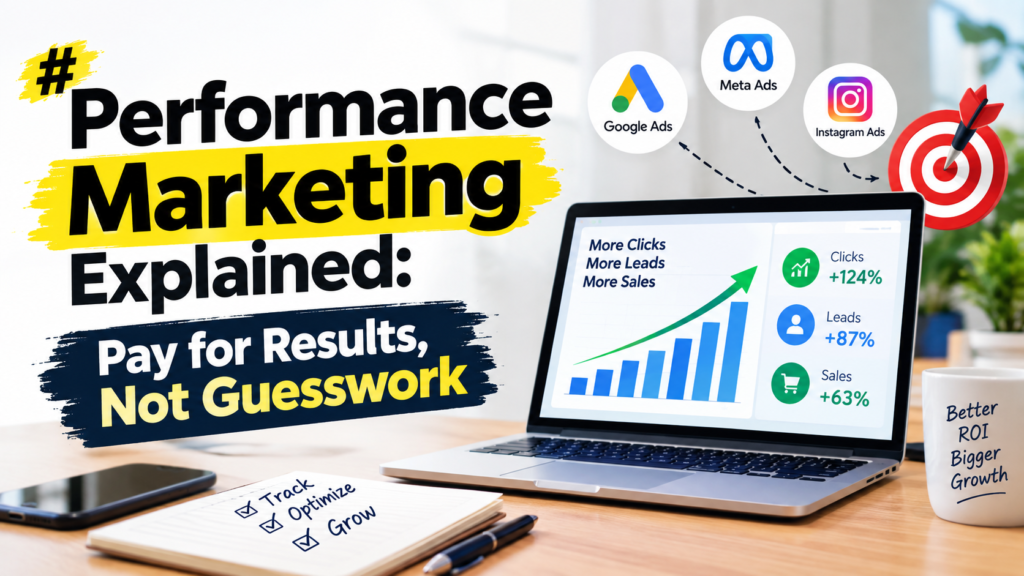
Guide Performance Marketing Explained: Pay for Results, Not Guesswork By the माटीVERSE team, 5 min read ImpressionsClicksEnquiries Only the last bar pays the bills. Many businesses run ads the same way: set a budget, launch, and hope. A few weeks later the money is spent, the report shows clicks and impressions, and nobody can say whether it worked. Performance marketing fixes exactly that. Every rupee is tied to a measurable action: an enquiry, a purchase, a sign-up. What it actually means Traditional advertising pays for exposure: a billboard, a newspaper slot, a TV spot. You hope people notice, but can’t see who responded. In performance marketing, you decide in advance what counts as success and measure everything against it. The campaign is judged by results, not by how many people saw it. If something isn’t working, you see it quickly and change it. Judge ads by what they deliver, not what they display. Where it happens Search adsReach people actively looking for what you offer. Social adsMeta, LinkedIn, YouTube: reach the right audience before they search. RetargetingBring back visitors who didn’t act the first time. Affiliate and partnersPay partners only when they deliver a result. The right mix depends on your audience and goal. A local service business may get most value from search, while a new brand may need social ads to create demand first. The metrics that matter Conversion rateThe share of visitors who take the action you want. CPA / CPLWhat you spend to win one customer or one enquiry. ROASRevenue earned for each rupee spent on ads. CAC vs. valueWhether a customer is worth more than it cost to win them. Clicks and impressions help with diagnosis, but they aren’t results. A campaign with cheap clicks and no enquiries is losing money quietly. Tracking comes first The most common reason performance campaigns fail has little to do with the ads. It’s missing or broken tracking. If form fills, calls, and purchases aren’t recorded, you’re optimizing blind, and the ad platforms can’t learn who your best customers are either. Before you spend, check that conversions are set up as goals, your analytics and ad accounts are connected, and you can tell which campaign produced which enquiry. Five common mistakes 1. Starting without a clear goal “More awareness” isn’t a performance goal. “Twenty qualified enquiries a month at an acceptable cost” is. 2. Sending traffic to a weak page The best ad can’t rescue a page with no clear message or next step. A fast, focused page usually beats your homepage. 3. Judging too early or too late Changing everything after two days stops the platform learning. Waiting two months without review wastes budget. 4. Never refreshing the creative Audiences tire of the same ad. Test different messages and formats, and keep what works. 5. Ignoring lead quality Cheap leads that never become customers aren’t cheap. Track what happens after the enquiry. How to start Define one goal. Leads, sales, or sign-ups, with a rough target. Set up tracking. Make sure every important action is recorded. Fix the landing page. One message, one action, fast on mobile. Start small, test widely. Try a few audiences and messages on a modest budget. Review on a rhythm. Check weekly, move budget to what works, pause what doesn’t. Is your business ready? Performance marketing works best when your offer is clear, your website can convert visitors, and you can follow up on enquiries quickly. If one of these is weak, fixing it first makes every ad rupee go further. It isn’t about spending more. It’s about spending with clarity: knowing what you want, measuring whether you got it, and improving steadily. Running ads without knowing what they deliver? At माटीVERSE, we build performance campaigns on top of strategy: your goals, your audience, and your tracking first, so your budget works from day one. Get a free strategy audit
Digital Marketing Agency for E-commerce Startups: How to Choose
E-commerce Marketing Digital Marketing Agency for E-commerce Startups: What to Look for Before You Hire Building an online store is the easy part. Getting the right people to find it, trust it and buy from it is where most e-commerce startups struggle. A good digital marketing agency can shorten that journey, but only if you know what to ask for. Why e-commerce startups need a different approach A startup has no brand recall, no customer base and usually a limited budget. That changes what marketing has to do: Build trust fast. Shoppers buying from an unknown store look for proof: a clear brand, good visuals, honest product pages and a social presence that looks alive. Earn every visit. Without existing traffic, you depend on search, social content and paid ads to bring people in. Learn quickly. In the early months, you are testing which products, messages and channels work. An agency should help you read the data, not just spend the budget. Services that matter most in the first year You do not need everything on day one. These are the areas that usually move the needle for a new store. 1 Brand identity and visual system Your logo, colours, typography and templates should look consistent on your website, social pages and ads. A consistent look is what makes a new store feel credible. 2 Website development and SEO A fast, mobile-friendly store with clean product pages is the base of everything else. SEO helps your products and category pages appear in search results over time, so you depend less on paid traffic. 3 Social media management and short-form video Reels and shorts let you show your product in use, share your story and reach people who have never heard of you. Regular posting, replying to comments and watching which content performs are what keep a page active. 4 Performance marketing Meta and Google ads can bring in targeted buyers quickly. The key is creative testing and tracking return on ad spend, so you scale what works and stop what does not. 5 Influencer and creator partnerships For many product categories, a recommendation from a creator the audience already follows carries more weight than an ad. Well-matched creators can bring both reach and conversions. 6 PR and media coverage Press mentions, features and thought-leadership articles add credibility and support your search visibility. For a new brand, this helps you look established sooner. How to choose the right agency Before signing, ask these questions: Have they worked with e-commerce brands? Look for relevant examples, not just a long client list. How do they measure success? Good answers mention sales, cost per acquisition and return on ad spend, not only likes and impressions. Can they handle more than one channel? When SEO, content, social and ads work together, results build on each other. A single connected team avoids gaps and mixed messaging. Is reporting clear? You should know what was done, what it cost and what happened as a result. Is the engagement flexible? A startup’s priorities change quickly. Avoid long, rigid contracts that cannot adapt. Do they understand your stage? An agency that suggests a huge budget before understanding your product, margins and audience is not the right fit. Red flags to avoid Think twice if you see: Guaranteed sales or “overnight” growth No questions about your product, pricing or target customer Vague reports with no connection to revenue Lock-in contracts with no clear deliverables A simple way to start Begin with a small, focused plan: fix your brand basics and website, launch a content routine on the platforms your customers use, and run a limited ad test to find your best product and message. Then expand based on real data. Final thoughts The right digital marketing agency acts like an extension of your team. It brings strategy, creative work and execution together so that your store is easy to find, easy to trust and easy to buy from. Choose a partner who is honest about what is realistic, clear about how they measure results, and ready to grow with you. Planning to launch or scale your online store? Talk to us about a marketing plan built around your product and budget. Talk to Us